


If you have been searching for a provider that offers BPC-157 in Treasure Valley, you are not just curious. You are probably dealing with an injury, chronic pain or inflammation that will not go away. BPC-157 is one option patients ask about, though the human evidence behind it is still limited.
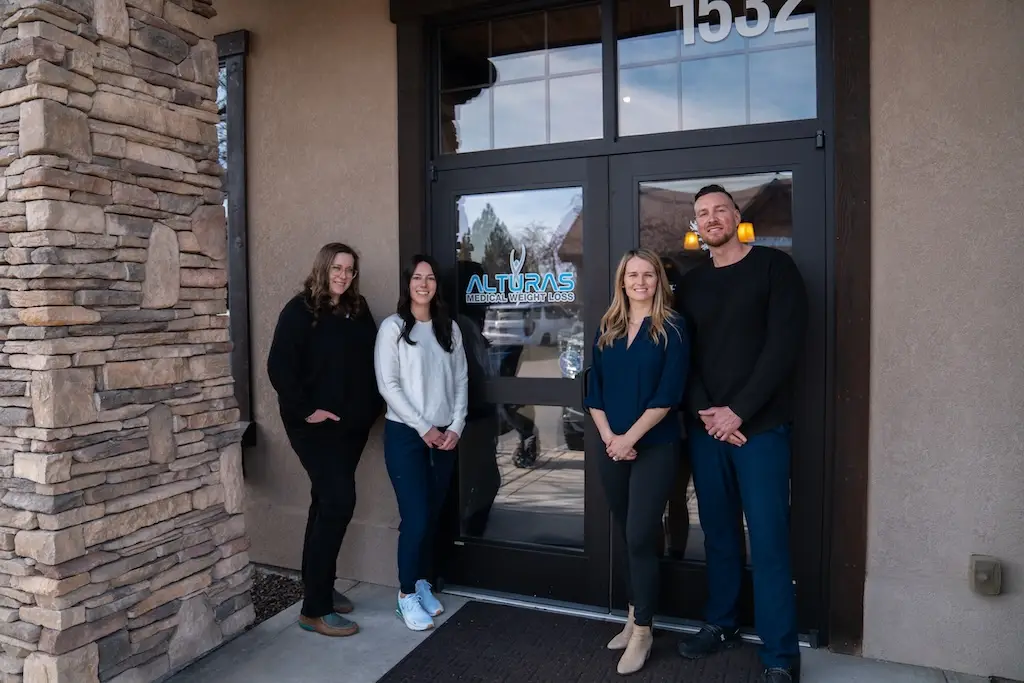
Alturas Medical Weight Loss is a physician-owned medical clinic in Meridian that can prescribe BPC-157! Dr. Ashley Southern, NMD reviews your labs and your history before prescribing anything.
We are about 15 minutes from downtown Boise, and closer if you are in Eagle.
Every peptide we prescribe is manufactured in the United States, never shipped from an unknown source.
★★★★★ 4.9 from 120+ Google reviews
Physician-Prescribed
Never sold from a website
Made in the USA
Every peptide we prescribe is made in the United States
Meridian Clinic
15 minutes from downtown Boise
BPC-157 is a synthetic peptide made of 15 amino acids.
The sequence comes from a protein found in human gastric juice. That is where the name comes from: Body Protection Compound-157. It is not a steroid. It is not a growth hormone. It is not a supplement.
Candidacy is decided by medical evaluation, not by a checklist. The situations below are common reasons patients ask about BPC-157. None of them qualifies you on its own.
Dr. Ashley Southern, NMD reviews your history, your lab work and the specific problem first. Nothing is prescribed before that evaluation. Recovery peptides also do not replace physical therapy, sleep, protein intake or an accurate diagnosis.
Explore the full physician-supervised peptide therapy if recovery is only part of what you are solving. Low desire is a different problem, and PT-141 for low sexual desire is the protocol for it.
Searching for BPC-157 in Boise? Our clinic is in Meridian, roughly fifteen minutes from downtown Boise. That puts us central to the whole Treasure Valley. We see patients from Eagle, Nampa, Kuna, Star, Middleton and Caldwell.
Alturas Medical Weight Loss
1532 W Cayuse Creek Dr
Meridian, ID 83646
(208) 690-2040
Alturas Medical Weight Loss is a physician-led clinic. We are not a subscription service and not a website checkout. Dr. Ashley Southern, NMD prescribes and oversees every plan.You can review our wider peptide therapy program for context.
Every protocol at Alturas Medical Weight Loss starts the same way, and none of it happens through a questionnaire.
Start with a free fifteen minute phone consultation. If a recovery protocol suits you, we order labs. We review your history and the specific injury. Dr. Southern then prescribes and monitors the plan. She adjusts it based on how you respond. You can see how this fits our wider peptide therapy in Boise and Meridian. You can also compare it with the Wolverine Stack.
No. BPC-157 is not an FDA approved drug for any condition. Anyone who tells you otherwise is wrong.
The compounding picture is more complicated, and it moved in 2026. Here is what the FDA’s own records show, with sources.
BPC-157 is not on the Category 2 list. Category 2 is the FDA list of bulk drug substances that may present significant safety risks in compounding. BPC-157 was on that list. It now appears instead in the FDA table of nominations that were withdrawn.
Being withdrawn from Category 2 is not the same as being approved. It means the nomination was pulled. It does not mean the FDA approved the substance for compounding.
The FDA scheduled a further review. Its Pharmacy Compounding Advisory Committee met on July 23 and 24, 2026. BPC-157 was on the agenda for possible addition to the 503A bulks list. The review was tied to an ulcerative colitis indication.
FDA has posted no minutes or voting results. Trade press (AJMC, RAPS) reported that the committee voted 8 to 6, with 1 abstention, to recommend adding BPC-157 to the 503A bulks list. That vote is a non-binding recommendation, and FDA has not proposed adding it.
Where that leaves it today. BPC-157 is not approved. It is not in Category 2. BPC-157 is not currently included in Category 1 of FDA’s 503A interim compounding framework. Its use in humans is investigational, and federal compounding requirements apply.
BPC-157 also appears on the World Anti-Doping Agency prohibited list. If you are a tested athlete, this is not an option. We will tell you so.
Primary sources
BPC-157 regulatory status, straight from the FDA
Research into BPC-157 is ongoing. Most of the available evidence comes from laboratory and animal studies. Human clinical evidence remains limited.
2025 systematic review, HSS Journal
In the authors’ words, “No study assessed the safety or adverse events of BPC-157 in humans.” They concluded that the absence of clinical outcome and safety data prevents evidence based practice guidelines.
Preclinical results should not be read as proof that BPC-157 treats injuries or medical conditions in people. Animal healing data is a reason to study something further. It is not a reason to promise an outcome.
At Alturas we think patients should understand both the potential and the limits of an emerging therapy. That is the only honest basis for a treatment decision.
Sources
The research behind this page
Last reviewed: October 2026
Dr. Ashley Southern, NMD
Physician and co-founder, Alturas Medical Weight Loss in Meridian, Idaho. Board-certified Naturopathic Medical Doctor prescribing and supervising every peptide protocol at the clinic.
Peptides are an area where the gap between a supervised medical protocol and something bought online is enormous. Dr. Southern’s background in regenerative medicine is the reason Alturas offers them at all. It is also why every protocol here starts with a conversation, and lab work whenever it is medically appropriate, rather than a checkout page.
Credentials at a glance
Read more on the Meet Dr. Ashley Southern page, or book a free consultation.
BPC-157 is one peptide. The Wolverine Stack pairs BPC-157 with TB-500. TB-500 is a synthetic fragment of thymosin beta-4. You can read about TB-500 therapy in Boise on its own.
The theory behind pairing them is complementary mechanisms. One supports local tissue repair. The other supports cell migration toward the injury.
One point deserves to be clear. The combination has never been studied as a combination in humans. Stacking two investigational peptides does not double the evidence behind either one.
Whether one peptide or the pairing suits you is a clinical decision. It is not a menu choice. Sorting that out is part of what the consultation is for.
BPC-157 is one of several physician-prescribed peptides we offer at our Meridian clinic, near Boise. Every plan starts with a medical evaluation. Explore our full peptide therapy in Boise program or the related therapies below.
A GHRH analog studied for its effects on visceral adipose tissue and body composition.
Bremelanotide, which acts on melanocortin receptors in the brain. The FDA-approved version (Vyleesi) is approved for low sexual desire in premenopausal women; other uses are off-label.
An investigational peptide fragment of thymosin beta-4, studied primarily in laboratory research involving tissue repair and wound healing.
A combination of BPC-157 and TB-500 considered in physician-supervised recovery protocols.
Two peptides studied for their effects on growth hormone signaling, through different pathways. Human data on each is limited, and the combination has not been studied in humans.
The questions people actually ask before starting, answered straight.
BPC-157 is a synthetic peptide made of 15 amino acids. The sequence is based on a protein found in human gastric juice. The name stands for Body Protection Compound-157. Most research has been done in animals. It looks at tissue repair in tendon, ligament, muscle and the gut lining. It is not a steroid, a growth hormone or a supplement.
No. BPC-157 is not FDA approved for any condition. No clinic can honestly claim otherwise. On compounding, the FDA no longer lists it in Category 2. It now sits in the FDA table of withdrawn nominations. It is not currently included in Category 1 of FDA’s 503A interim compounding framework either. An FDA advisory committee reviewed it in July 2026. Trade press reported an 8 to 6 vote to recommend adding it to the 503A bulks list. The vote is non-binding, FDA has posted no official results, and FDA has not acted on it.
It was never banned, and it is no longer flagged. The FDA had placed BPC-157 in Category 2, its list of bulk substances that may present significant safety risks in compounding. It is no longer on that list. The FDA now shows it among nominations that were withdrawn. Withdrawn is not the same as approved.
Research has looked at tendon and ligament healing, muscle injury and the gut lining. The human evidence is limited to a few small pilot studies, including a knee-pain review, plus early bowel-disease trials that were never fully published. No controlled trial has tested it for sports injuries. People usually ask about it after an injury stalls, or when recovery slows with age.
The honest answer is mixed. The animal data is genuinely interesting. The human data is thin. Most claims online are extrapolated from rodent studies. If a clinic quotes you a success rate in humans, ask where the number came from. We would rather say this up front than after you have paid for a protocol.
Nobody knows, and the two are not interchangeable. Oral forms have mainly been studied for effects inside the digestive tract. Whether a capsule delivers useful amounts of intact peptide to a tendon or joint is an open question. It is not settled science.
There is no reliable published timeline in humans. Any clinic quoting you a specific number of days is guessing. That is one reason a protocol here is monitored and adjusted. We do not sell it as a fixed course.
Long term human safety data barely exists. That absence is itself the most important safety fact. Reported effects in short term use are generally mild and local. The bigger real world risk is product quality. Peptides bought online are often mislabelled or contaminated, and nothing about that purchase is regulated.
Not if you are drug tested. BPC-157 appears on the World Anti-Doping Agency prohibited list under non approved substances. That means it is banned at all times, in and out of competition. If you compete under WADA, USADA or NCAA rules, we will decline to prescribe it.
BPC-157 is not a controlled substance in Idaho. The complication is federal rather than state. It is not FDA approved and is not currently included in Category 1 of FDA’s 503A interim compounding framework. It does not currently meet Section 503A’s bulk drug substance criteria, so FDA’s interim enforcement discretion does not apply. This is a question for a physician, not a website.
No. BPC-157 is a single peptide. The Wolverine Stack is an informal name for BPC-157 used together with TB-500. Which one suits you is a clinical judgement. You can read more on our Wolverine Stack page.
Alturas Medical Weight Loss is in Meridian, Idaho. We are at 1532 W Cayuse Creek Dr, about fifteen minutes from downtown Boise. There is free on-site parking. We also see patients from Eagle, Nampa, Kuna, Star, Middleton and Caldwell. Start with a free fifteen minute call at (208) 690-2040.
Our clinic is in Meridian, Idaho, with free on-site parking. We are about fifteen minutes from downtown Boise. The first step is a free fifteen minute phone call. There is no commitment. You will get an honest answer about whether this suits you.